Tuesday, May 15, 2012

Next Book?

Today's question for Stephanie is:  
What would you do differently if you were to write another book?  Her response gives us some cool insight into her writing struggles and what she's learned.


I started working with an editor, Jennifer Baumer, after I’d been writing ‘Scarlet Begonias’ for about a year and found out that I’d written the first 150 pages using a frack’d up point of view.  I was using a 3rdperson narrator, but I wanted to be inside everybody’s head at once, and that just isn’t allowed.  So, I ended up assigning each chapter to a character, and allowed my narrator to be privy to the contents of one head per chapter.  I also only allowed the reader to hear the internal chatter (written in italics) of a character if it was ‘their’ chapter.  I spent months of backtracking and cutting in order to clean up the POV issues.

Also at around the 150 page mark (after cleaning up the POV), I bought Noah Lukeman’s book ‘The First Five Pages: A Writer's Guide To Staying Out of the Rejection Pile’ (or did you buy that for me?  yes).  This book made it abundantly clear that I had to re-write the first 150 again.  I started with the first five pages, and re-wrote them for about a month.  Sometimes I would spend an hour on a paragraph.  But, after implementing the POV lessons and the lessons from Lukeman’s book (as well as those from ‘The Elements of Style’ by William Strunk, E. B. White and Roger Angell), I had transformed myself into a real writer.

So, for my next book, I think I can trim about a year or more off of the 3.5 years it took me to write (and re-write, and re-write) this one.

One thing that I won’t change is the need to craft and stick to an outline. Without it, I would have been a rambling idiot.  When I started, my outline had about 25 chapters, each with distinct settings, characters, and a basic description of my goal for plot development.  I initially kept my chapters short, and only tried to accomplish the goal of moving the story forward, not caring if the dialog was shallow or my sentence structure sounded like a 5th grader was writing it.  My goal was to write five pages per chapter, which was a very realistic goal on a chapter by chapter basis.  And then, before I knew it, I’d written 125 very crappy pages!

But, once you poop out those first 100+ pages, and let it just be stinky poop, then you’re really rolling.  It’s all downhill and super-fun after that.  I love editing.

OK, another thing that I would change is to be more organized.  I wrote on my laptop on the train and copied stuff to a flash drive to save at work so I could email it to my editor and emailed little blurbs of wiki research to myself and rammed post-its into my backpack with single words to jog my memory about something (my memory is AWFUL). After writing this, I realize that it just won’t be possible.  I am a scattered writer – period. Even now I have a bunch of email addresses, and a website, and facebook, and linked in, and create space, and the cosmicpals blog, and twitter – staying organized is very hard.

Monday, May 14, 2012

String Theory

Well I asked for Stephanie's thoughts on String Theory and I got that and more.


My thoughts / questions on string theory:
 
1)  How were the intitial strings (filaments of energy) detected in the 1970s.  Or are the strings theoretical from the get go?
 
2) Below (in The Basic Elements of String Theory) it says "you can’t construct a string theory without closed strings."   My gut tells me that you can't have a theory of everything with open strings.  Everything is spherical (eliptical), elastic, and the sum of which always totals 100%.
 
3)  I think of energy filaments as cosmic music (vibrations at frequencies which far exceed our limited perception between 20 and 20,000 hz).  However, the music is made with "strings" that are spherical(ish) and connected, not like a guitar string that has a beginning and ending.  Cosmic music has always existed and always will, and the concept of time provides the space which allows us to observe the vibration of the strings. 
 
4) As far as quantum gravity, I view gravity as external pressure upon an object, not a pulling inward due to mass.  I imagine that objects are dense because of space-time displacement.  This occurs when the vibrations of the membranes (musical onion skins that form the closed, spherical(ish) universe) interact with eachother to cause interference (density) or phase cancellation (vacuums) - imagine throwing a handful of pebbles into a lake and watching the patterns (peaks and valleys) of the overlapping concentric circles that form. This view of gravity could be wrong, but it just seems right. 
 
5) Compactification of dimensions - I have a problem with the concept of dimension to begin with.  On the grandest of scales (which is the vantage point we are aiming for), the limitations of dimensions keep us from imagining the whole enchilada as a borg-like, single unit.
 
------
Dimensionless concepts

Constants

Main article: Dimensionless number
The dimensionless constants that arise in the results obtained, such as the C in the Poiseuille's Law problem and the \kappa in the spring problems discussed above come from a more detailed analysis of the underlying physics, and often arises from integrating some differential equation. Dimensional analysis itself has little to say about these constants, but it is useful to know that they very often have a magnitude of order unity. This observation can allow one to sometimes make "back of the envelope" calculations about the phenomenon of interest, and therefore be able to more efficiently design experiments to measure it, or to judge whether it is important, etc.

Formalisms

Paradoxically, dimensional analysis can be a useful tool even if all the parameters in the underlying theory are dimensionless, e.g., lattice models such as the Ising model can be used to study phase transitions and critical phenomena. Such models can be formulated in a purely dimensionless way. As we approach the critical point closer and closer, the distance over which the variables in the lattice model are correlated (the so-called correlation length, \xi ) becomes larger and larger. Now, the correlation length is the relevant length scale related to critical phenomena, so one can, e.g., surmize on "dimensional grounds" that the non-analytical part of the free energy per lattice site should be \sim 1/\xi^{d} where d is the dimension of the lattice.
It has been argued by some physicists, e.g., Michael Duff,[4][6] that the laws of physics are inherently dimensionless. The fact that we have assigned incompatible dimensions to Length, Time and Mass is, according to this point of view, just a matter of convention, borne out of the fact that before the advent of modern physics, there was no way to relate mass, length, and time to each other. The three independent dimensionful constants: cħ, and G, in the fundamental equations of physics must then be seen as mere conversion factors to convert Mass, Time and Length into each other.
Just as in the case of critical properties of lattice models, one can recover the results of dimensional analysis in the appropriate scaling limit; e.g., dimensional analysis in mechanics can be derived by reinserting the constants ħ, c, and G (but we can now consider them to be dimensionless) and demanding that a nonsingular relation between quantities exists in the limit c\rightarrow \infty\hbar\rightarrow 0 and G\rightarrow  0. In problems involving a gravitational field the latter limit should be taken such that the field stays finite.
 
 
----------------------------

http://www.dummies.com/how-to/content/the-basic-elements-of-string-theory.html

The Basic Elements of String Theory

Five key ideas are at the heart of string theory. Become familiar with these key elements of string theory right off the bat. Read on for the very basics of these five ideas of string theory in the sections below.

Strings and membranes

When the theory was originally developed in the 1970s, the filaments of energy in string theory were considered to be 1-dimensional objects: strings. (One-dimensional indicates that a string has only one dimension, length, as opposed to say a square, which has both length and height dimensions.)
These strings came in two forms — closed strings and open strings. An open string has ends that don’t touch each other, while a closed string is a loop with no open end. It was eventually found that these early strings, called Type I strings, could go through five basic types of interactions, as shown this figure.
Type I strings can go through five fundamental interactions, based on different ways of joining and
Type I strings can go through five fundamental interactions, based on different ways of joining and splitting.
The interactions are based on a string’s ability to have ends join and split apart. Because the ends of open strings can join together to form closed strings, you can’t construct a string theory without closed strings.
This proved to be important, because the closed strings have properties that make physicists believe they might describe gravity. Instead of just being a theory of matter particles, physicists began to realize that string theory may just be able to explain gravity and the behavior of particles.
Over the years, it was discovered that the theory required objects other than just strings. These objects can be seen as sheets, or branes. Strings can attach at one or both ends to these branes. A 2-dimensional brane (called a 2-brane) is shown in this figure.
In string theory, strings attach themselves to branes.

Quantum gravity

Modern physics has two basic scientific laws: quantum physics and general relativity. These two scientific laws represent radically different fields of study. Quantum physics studies the very smallest objects in nature, while relativity tends to study nature on the scale of planets, galaxies, and the universe as a whole. (Obviously, gravity affects small particles too, and relativity accounts for this as well.) Theories that attempt to unify the two theories are theories of quantum gravity, and the most promising of all such theories today is string theory.

Unification of forces

Hand-in-hand with the question of quantum gravity, string theory attempts to unify the four forces in the universe — electromagnetic force, the strong nuclear force, the weak nuclear force, and gravity — together into one unified theory. In our universe, these fundamental forces appear as four different phenomena, but string theorists believe that in the early universe (when there were incredibly high energy levels) these forces are all described by strings interacting with each other.

Supersymmetry

All particles in the universe can be divided into two types: bosons and fermions. String theory predicts that a type of connection, calledsupersymmetry, exists between these two particle types. Under supersymmetry, a fermion must exist for every boson and vice versa. Unfortunately, experiments have not yet detected these extra particles.
Supersymmetry is a specific mathematical relationship between certain elements of physics equations. It was discovered outside of string theory, although its incorporation into string theory transformed the theory into supersymmetric string theory (or superstring theory) in the mid-1970s.
Supersymmetry vastly simplifies string theory’s equations by allowing certain terms to cancel out. Without supersymmetry, the equations result in physical inconsistencies, such as infinite values and imaginary energy levels.
Because scientists haven’t observed the particles predicted by supersymmetry, this is still a theoretical assumption. Many physicists believe that the reason no one has observed the particles is because it takes a lot of energy to generate them. (Energy is related to mass by Einstein’s famous E = mc2 equation, so it takes energy to create a particle.) They may have existed in the early universe, but as the universe cooled off and energy spread out after the big bang, these particles would have collapsed into the lower-energy states that we observe today. (We may not think of our current universe as particularly low energy, but compared to the intense heat of the first few moments after the big bang, it certainly is.)
Scientists hope that astronomical observations or experiments with particle accelerators will uncover some of these higher-energy supersymmetric particles, providing support for this prediction of string theory.

Extra dimensions

Another mathematical result of string theory is that the theory only makes sense in a world with more than three space dimensions! (Our universe has three dimensions of space — left/right, up/down, and front/back.) Two possible explanations currently exist for the location of the extra dimensions:
  • The extra space dimensions (generally six of them) are curled up (compactified, in string theory terminology) to incredibly small sizes, so we never perceive them.
  • We are stuck on a 3-dimensional brane, and the extra dimensions extend off of it and are inaccessible to us.
A major area of research among string theorists is on mathematical models of how these extra dimensions could be related to our own. Some of these recent results have predicted that scientists may soon be able to detect these extra dimensions (if they exist) in upcoming experiments, because they may be larger than previously expected.

Math Revisted

I asked Stephanie last week if she thought the universe was made of math.  Well, now that she has had time to think about it she'd like to add some more info to the math thingy.  


Here's the deal:


You had asked if everything was math, and I said no, that math describes everything, but maybe the answer should be that recurring patterns, like the fibonacci sequence's golden spiral and the golden ratio, and constants like pi, are the glue that binds together the inter-relatedness of everything.
 

In 2003, Volkmar Weiss and Harald Weiss analyzed psychometric data and theoretical considerations and concluded that the golden ratio underlies the clock cycle of brain waves.[52] In 2008 this was empirically confirmed by a group of neurobiologists.[53]
In 2010, the journal Science reported that the golden ratio is present at the atomic scale in the magnetic resonance of spins in cobalt niobate crystals.[54]
Several researchers have proposed connections between the golden ratio and human genome DNA.[55][56][57]
However, some have argued that many of the apparent manifestations of the golden mean in nature, especially in regard to animal dimensions, are in fact fictitious.[58]
 The golden ratio is also used in the analysis of financial markets, in strategies such as Fibonacci retracement.

Saturday, May 12, 2012

Unraveling the Ego


YOU ASKED:  Is it possible to unravel the ego? And if so, to what end.

I AM ASKING YOU:  What does it mean to unravel the ego?  Please explain.


The disolution of the ego is a transcendence of the idea that one even has any actual, non-illusory "ego" with which to experience death in the first place.
 
Ego death is said to be characterized as the perceived loss of the accustomed feeling of existing as a "personal agent" and in its place, the perception that one is the whole universe (and therefore there is no need to differentiate the "I" from the "universe") or by simply acknowledging that the "I" does not exist.
 
---
 
According to Carlos Castaneda (via Don Juan):
 
For a sorcerer, reality, or the world we all know, is only a description that has been pounded into you from the moment you were born.  The reality of our day-to-day life, then, consists of an endless flow of perceptual interpretations which we have learned to make in common.
I am teaching you how to see as opposed to merely looking, andstopping the world is the first step to seeing.  The sorcerer's description of the world is perceivable. But our insistence on holding on to our standard version of reality renders us almost deaf and blind to it.

When you begin this teaching, there is another reality, that is to say, there is a sorcery description of the world, which you do not know. As a sorcerer and a teacher, I am teaching you that description. What I am doing with you consists, therefore, in setting up that unknown reality by unfolding its description, adding increasingly more complex parts as you go along.

In order to arrive at seeing one first has to stop the worldStopping the world is indeed an appropriate rendition of certain states of awareness in which the reality of everyday life is altered because the flow of interpretation, which ordinarily runs uninterruptedly, has been stopped by a set of circumstances alien to that flow. In this case the set of circumstances alien to our normal flow of interpretations is the sorcery description of the world. The precondition for stopping the world is that one has to be convinced; in other words, one has to learn the new description in a total sense, for the purpose of pitting it against the old one, and in that way break the dogmatic certainty, which we all share, that the validity of our perceptions, or our reality of the world, is not to be questioned.

After stopping the world the next step is seeing. By that I mean what could be categorized as responding to the perceptual solicitations of a world outside the description we have learned to call reality.


Friday, May 11, 2012

Math


After watching the pilot episode of a TV show called Touch, I couldn't help but ask myself, is the universe  made of math?  How the hell should I know?  BUT THEN!  I thought of my cosmic pal, Stephanie and figured she could give me a good answer on this one.  Of course she did.  :)


Math is just a language to try and explain the universe.  There’s lots of kinds of math (geometry, non-Euclidean geometry, trigonometry, algebra, calculus, linear algebra, probability, …) and lots of sub-languages.  Some of the different sub-languages work well together, some are hard to relate.

Since most people (me included) will never understand the math needed to talk about the universe at the level of subtlety required to really poke at its underbelly, we are forced to believe what the Math Shamans tell us.

But we can think about (and construct new) concepts as theoretical mathematicians and possibly drive the number crunchers to devise a new math to test the voracity of our claims.

My next book will deal with prime numbers and their relationship to music (harmonics, tension, frequency, and trigonometry). 

If anyone has worked with the Riemann Hypothesis (Zeta Function), please contact me.
In mathematics, the Riemann hypothesis, proposed by Bernhard Riemann (1859), is a conjecture about the location of the nontrivial zeros of the Riemann zeta function which states that all non-trivial zeros (as defined below) have real part 1/2. The name is also used for some closely related analogues, such as the Riemann hypothesis for curves over finite fields.


Thursday, May 10, 2012

Supernatural


Today's question is: Have you ever experienced anything you would consider "supernatural"?

The supernatural (Medieval Latin: supernātūrālis: supra "above" +naturalis "nature", first used: 1520–30 AD)[1][2] is that which is not subject to the laws of nature, or more figuratively, that which is said to exist above and beyond nature.

But it’s all natural.  How can you experience more than all?


Bummer.  I was hoping for a good UFO or ghost story or a vision of God or something.  :)


Wednesday, May 9, 2012

Other Dimensions


I asked Stephanie what she thought about other dimensions.  Here is what she said.


Definitions:

Dimension - In physics and mathematics, the dimension of a space or object is informally defined as the minimum number of coordinates needed to specify any point within it.

Physical theories that incorporate time, such as general relativity, are said to work in 4-dimensional "space-time", (defined as a Minkowski space). Modern theories tend to be "higher-dimensional" including quantum field and string theories. The state-space of quantum mechanics is an infinite-dimensional function space. A tesseract is an example of a four-dimensional object.

Manifolds
A connected topological manifold is locally homeomorphic to Euclidean n-space, and the number n is called the manifold's dimension. One can show that this yields a uniquely defined dimension for every connected topological manifold. For connected differential manifolds the dimension is also the dimension of the tangent vector space at any point.

*** Did you notice that the main character of the book is named Mannie Foldsky (get it?)

The best-known treatment of time as a dimension is Poincaré and Einstein's special relativity (and extended to general relativity), which treats perceived space and time as components of a four-dimensional manifold, known as spacetime, and in the special, flat case as Minkowski space.

Superstring theory, M-theory and Bosonic string theory respectively posit that physical space has 10, 11 and 24 dimensions. These extra dimensions are said to be spatial. However, we perceive only three spatial dimensions and, to date, no experimental or observational evidence is available to confirm the existence of these extra dimensions. A possible explanation that has been suggested is that space acts as if it were "curled up" in the extra dimensions on a subatomic scale, possibly at the quark/string level of scale or below.

** This is what I have to say about String Theory – “Hogwash!”
I don’t know enough about the math to make the call with 100% certainty, but 11 dimensions seems preposterous and hardly elegant.

A Calabi–Yau manifold is a special type of manifold that shows up in certain branches of mathematics such as algebraic geometry, as well as in theoretical physics. Particularly in superstring theory, the extra dimensions of spacetime are sometimes conjectured to take the form of a 6-dimensional Calabi–Yau manifold.

*** I liked the look of this thing, so I started to imagine what six dimensions was all about.  It was the Calabi-Yau manifold that inspired the topology of the Qualia Spectarum – the map of the Dreamscape.
Description: File:Calabi yau.jpg

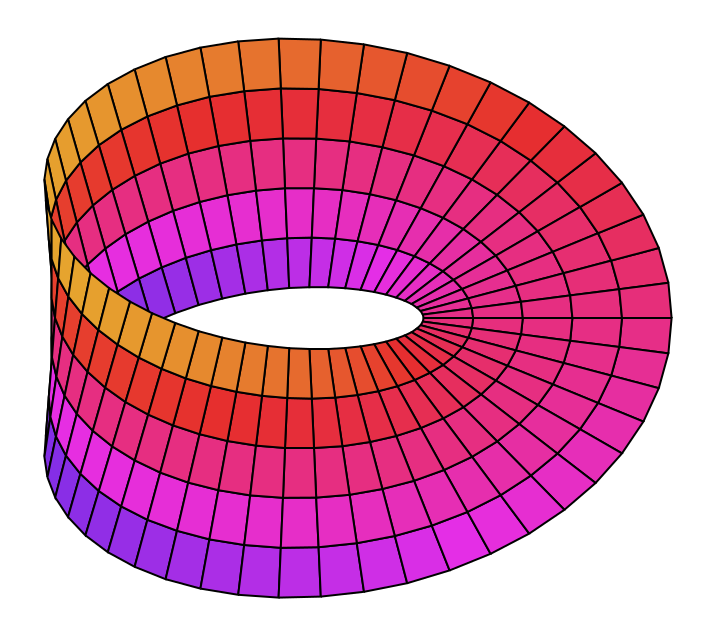
The other manifold that got my attention was the Klein bottle (the form of the bongs that the glass blowing Wiccans, Teek and Voltar, make in the book).  A Klein bottle is a non-orientable surface, informally, a surface (a two-dimensional manifold) in which notions of left and right cannot be consistently defined. Other related non-orientable objects include the Möbius strip and the real projective plane. Whereas a Möbius strip is a surface with boundary, a Klein bottle has no boundary. (For comparison, a sphere is an orientable surface with no boundary.)
Description: File:Klein bottle.svgDescription: File:Moebius strip.svg


*** What was the original question?... Thoughts on other dimensions
I think that there are theoretically infinite dimensions (I am a multi-dimensional database architect) and I can make an infinite number of dimensions which define a fact table.  However, the more dimensions you add, the larger the fact table will grow to accommodate all of the possible permutations until you need a computer the size of Texas to find out the answer to your question.